
I don’t know about you, but when I think of Barcelona, I think of the 1992 Summer Olympics.
There is no athlete or event that comes to mind, just that Barcelona was host. I think it’s because it’s the first Olympics I remember watching. I remember the Ben Johnson scandal in 1988, but I think I was otherwise too young so Barcelona is where a fascination with the Olympics probably started for me.
That said, with my starting point about 30 years out of date, I didn’t know what to expect when we arrived for a few days in Barcelona.
I had read about how Barcelona was engineering Europe’s longest automated subway network to link its peripheral neighborhoods, while Toronto spent fifteen gridlocked years wrestling with a single midtown light rail line.
I also knew that Barcelona is one of the tourist hubs that is starting to pushback on behalf of citizens who feel overwhelmed and pushed aside by tourists. Early this month, The New York Times published an interview with Barcelona’s new commissioner for sustainable tourism, José Antonio Donaire.
“We don’t want to grow more. We want the tourists that the city already has,” Donaire told The Times. They’re happy with the number of tourists they see annually and want to stop growth.
We just hoped we were counted among the number they already have.
Walking through Gaudí’s Barcelona
With our stop in Barcelona, Katy wanted to make sure that Ella had a chance to see some of the work by Antoni Gaudí, an architect who was an example of the modernisme movement and spent his career rejecting the straight lines of the industrial age.
I’ll admit I knew little about his work before our visit so it was just as educational for me. I knew of the Sagrada Familia, but his other work and that he did civil engineering work on top of buildings was new for me.
Casa Milà
Our first Gaudí stop was Casa Milà. When it was built between 1906 and 1912, locals hated it so much they nicknamed it La Pedrera (The Quarry) because of its heavy, undulating stone facade. Gaudí built the apartment block using a self-supporting stone structure, meaning he didn’t need traditional load-bearing walls and could top the roof with a collection of surreal, warrior-shaped chimneys.
While it looks entirely stylistic, the building was actually a massive leap forward for urban infrastructure. It introduced modern concepts like an integrated underground parking garage and flexible, open-floor plans that basically predicted the next 100 years of apartment design.
I found it to be the most livable of the two apartment buildings we visited. Lots of open space and natural light. Great if you were very rich and lived in Barcelona in the early 1900s.

Casa Batlló
A few blocks down on Passeig de Gràcia, Casa Batlló shows what happens when you give Gaudí a conventional, boring apartment building and ask him to remodel it. According to our guide, the owners told Gaudi to tear it down and rebuild, but he opted to keep the structure, gut it and add an exterior.
The exterior looks like something pulled from a Catalan myth, covered in iridescent shards of broken ceramic tiles with balconies shaped like skeletal masks and a roof that mirrors the spine of a dragon.
The house is a showcase of the trencadís mosaic style (using broken bits of ceramics to decorate). Gaudí demonstrated that rigid urban architecture could be completely rethought by prioritizing natural light, ventilation, and organic flow over strict, blocky grids.
Some of the most interesting elements were the little details.
A dumb waiter supported window allows for giant windows in the front that can still be lifted with ease for air. Door and cabinet handles have unusual shapes created by Gaudí holding clay in his hand to get ergonomic shapes, feeling that function was more important than looks. An interesting belief for someone who designed such over-the-top-looking buildings.

Sagrada Família
The most famous Gaudí stop was the Sagrada Familia basilica. It was apparently upgraded from church to basilica when the Pope visited and, presumably, said some magic words.
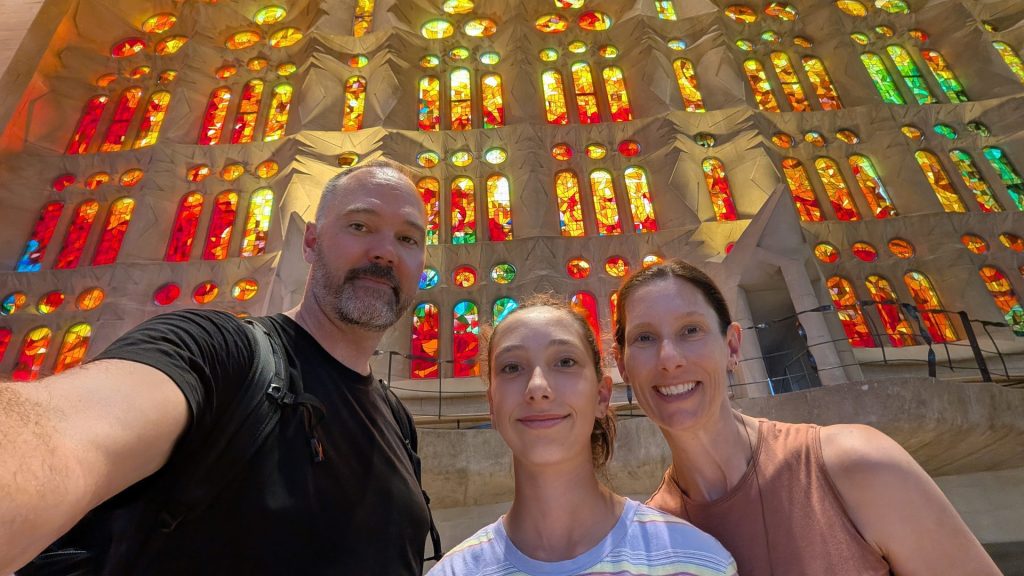
The church/basillica has been under construction since 1882, transforming into a massive forest of stone and stained glass where the columns branch out like trees to support the ceiling.
You may have read recently that the church was finally completed. That’s actually not the case. While the tower has reached its full height, making this the tallest church, they still have work to do.
The current estimate is 10-15 years more. It sounds like a long time, it is a long time, but compared to some other churches a couple hundred years is downright speedy.
An early, if backward example of working from home, Gaudí spent the final years of his life living on-site after getting tired of the commute from his previous onsite home at Park Güell.
It remains an impressive feat of engineering, challenging the norms of religious architecture by ditching heavy Gothic flying buttresses. Instead, it relies on complex mathematical curves and branching pillars that distribute weight far more efficiently than standard medieval building techniques.
We were lucky enough that our tour took place in the late afternoon, as the sun set on the side representing ‘the passion’ (death) of Christ, with vibrant red light streaming into the church.
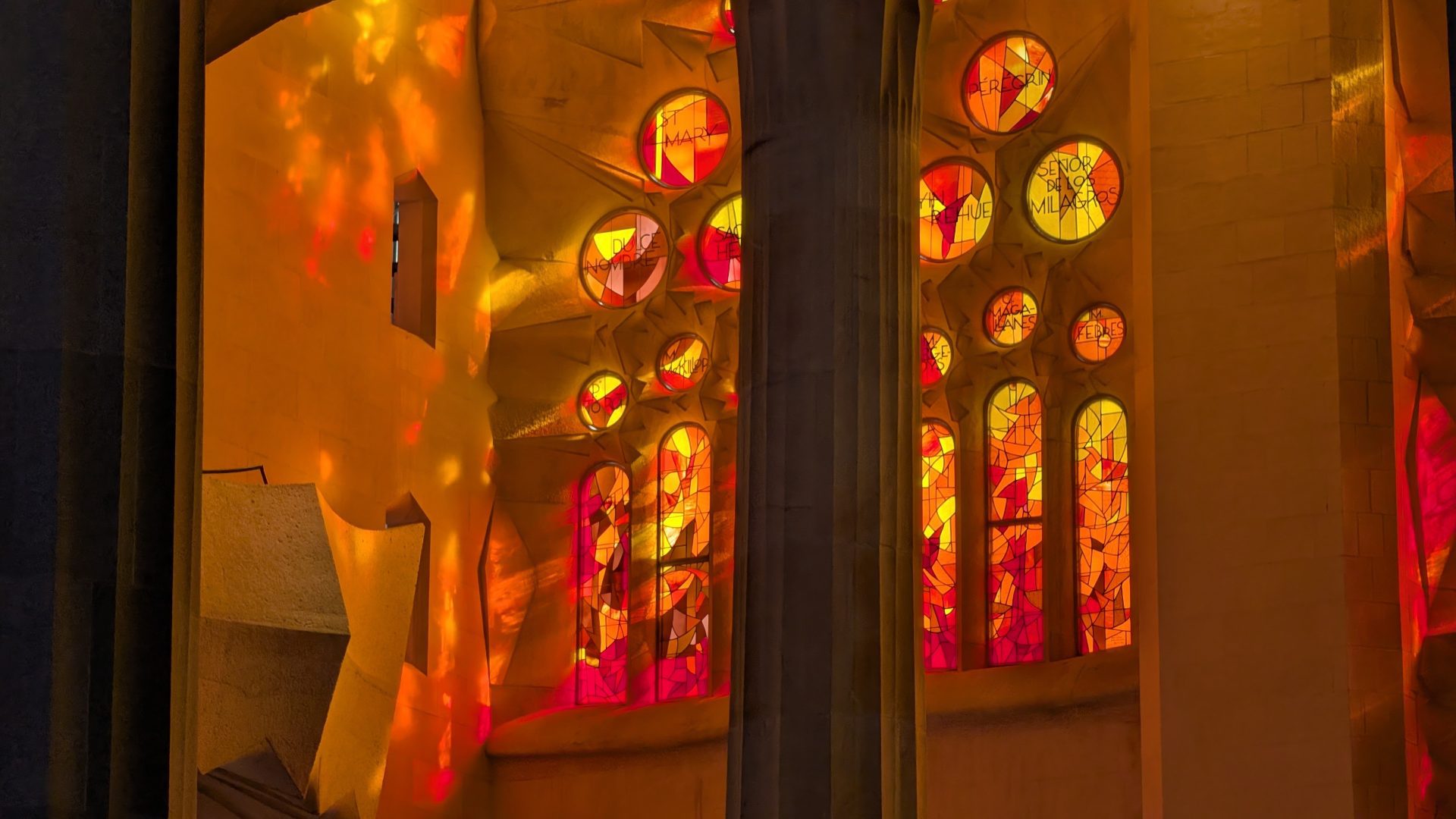
Gaudi was killed by a tram in 1926. While there was long talk of completing the structure for the centenary of his death, they had to settle for placing the cross atop the tower to mark the date.


Park Güell
Our final Gaudi stop was a park that was originally supposed to be an exclusive, gated residential development for Barcelona’s wealthy elite, but the real estate venture completely failed, and the city turned it into a public park in 1926. It turned out that in an era where showing face at all the fancy parties was important for the rich, nobody wanted to live on the far side of town up a hill.
Gaudí shaped the architecture directly into the rocky hillsides, building vaulted stone viaducts, a massive hall of columns, and a winding central terrace covered in colorful mosaic benches.
The park’s lasting legacy is how it pioneered early landscape architecture. It serves as a case study in blending human infrastructure with raw topography, showing the exact point where Gaudí scaled his organic ideas up from single private houses to an entire public ecosystem.
While it didn’t work as a business venture, walking around the park it’s not hard to see why the idea was appealing to Gaudi and his friend Güell, who backed the project and lived in a mansion on the property until his death in 1918.

A city for people
Coming from Toronto where we continue to suffer through battles between those who believe cities should be for people to live in (✋) and those, like our provincial Premier Doug Ford, who feel cities are things people in cars pass through, it couldn’t help but notice the cities-are-for-people team seems to be having much more success in Barcelona.
Bikes are just one example of this and happen to be our favourite way to visit a city. Barcelona isn’t Copenhagen or Amsterdam, but it’s definitely friendly to bikes.
Bikes let you cover more ground than on foot but slowly enough to actually appreciate what you see. They let you stop when something catches your attention and glide down little alleys a car would struggle to fit in. Ironically we were a few minutes late for our bike tour because we took an Uber to get to the starting point (no bikes available) and got caught in car traffic.
The tour we booked was with Steel Donkey Bike Tours who offer a chance to see things beyond the typical tourist sites for a look at how people live in Barcelona.
If our tour had a theme, I would say that it was Barcelona’s development, starting largely with what was done in preparation for the 1992 Olympics.
Those Olympics are seen as a lesson in using a major sporting event as a catalyst for actual civic transformation rather than a source of long-term debt, during Pasqual Maragall’s tenure as mayor of Barcelona.
As detailed in a Smart Cities Dive profile, Maragall used the lead-up to the 1992 Summer Olympics to completely overhaul the city’s infrastructure.
Instead of building temporary white elephants, his administration focused investments on permanent urban renewal: opening the city to the sea by reclaiming industrial beachfronts in Poblenou, constructing the ring roads, and expanding cultural venues across Montjuïc. The Games were essentially used as a funded deadline to accelerate a long-term urban master plan, laying the foundation for modern Barcelona as a global tourist and cultural hub.
A more recent, ground-level shift in Barcelona’s urban design that we visited on our tour are its superilla (superblock) model.
As outlined by The Urbanist, the city takes nine-block grids in neighborhoods like Sant Antoni and Poblenou and cuts off through-traffic, restricting motor vehicles to the outer perimeter.
By reclaiming the inner streets for bikes, pedestrians, and green space, the initiative cut nitrogen dioxide levels by 25% near pilot sites and turned high-volume traffic corridors into quiet, livable public spaces.

From the city to the Pyrenees
From Barcelona we head up into the Pyrenees to spend a few days hiking in Andorra. Trading the heat of the city for some cooler air in the mountains was a welcome change. With luck that post will follow.
In the meantime, if you want to read more about cities we’ve seen by bike, check out our previous bike tour adventures from Marrakesh, Copenhagen, and Cartagena.
Leave a Reply